
IRFC Q2 Results, Jio Financial Q2 Results, Angel One Q2 Results, Wipro Q2 Results and Polycab Q2 Results: Key Highlights for Investors
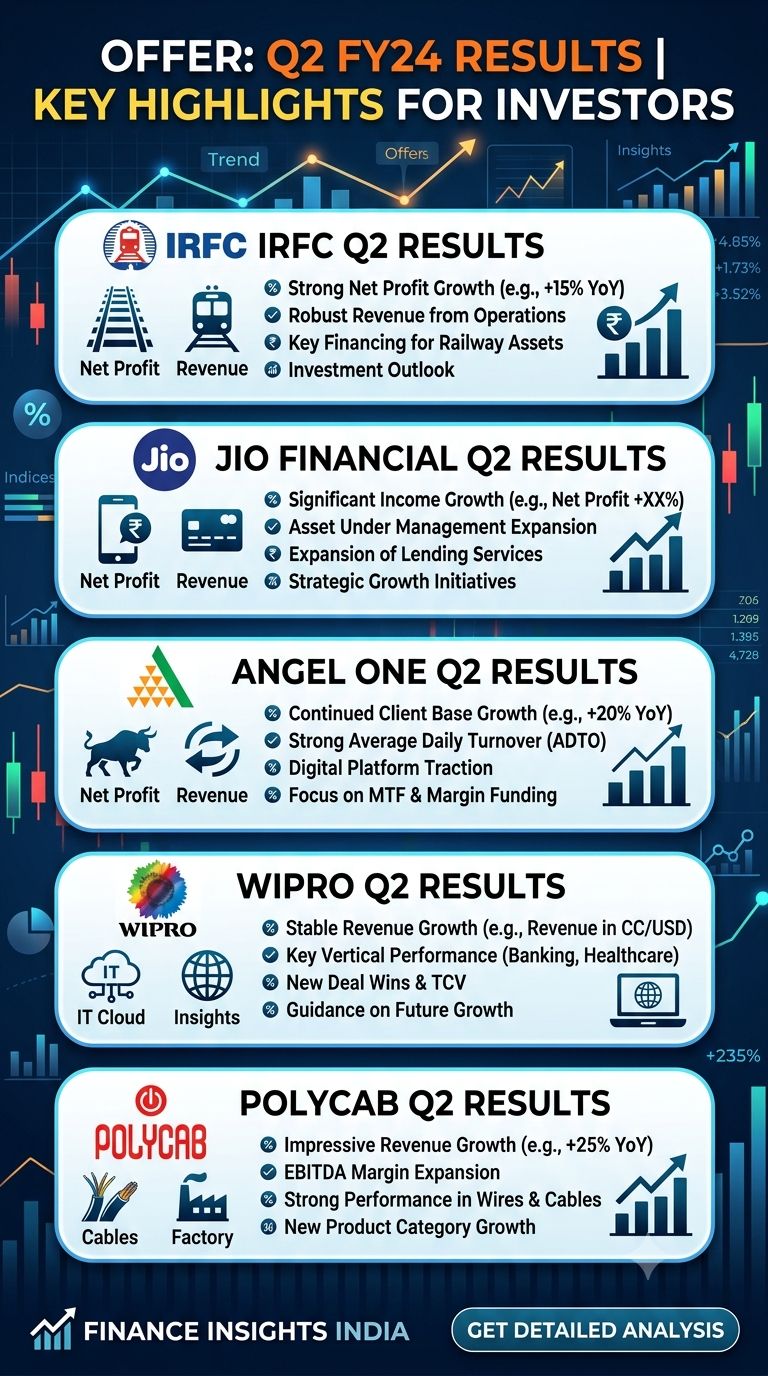
India’s September-quarter earnings season is bringing several major companies into the spotlight. The latest Q2 FY2026–27 results for Indian Railway Finance Corporation (IRFC), Jio Financial Services, Angel One, Wipro, and Polycab are important for investors tracking railway financing, financial report, stockbroking, IT services, and electrical equipment.
Among the notable developments, IRFC reported year-over-year profit growth, Jio Financial Services recorded strong growth in operating performance excluding dividend income, Angel One posted improved quarterly profitability, and Wipro delivered higher revenue despite a slight decline in net profit.
This article reviews the reported results, explains the numbers that matter, and highlights what investors should watch next. All financial figures are in Indian rupees unless stated otherwise.
1. IRFC Q2 Results: Profit Growth and Railway Financing in Focus
Indian Railway Finance Corporation (IRFC) plays an important role in financing India’s railway infrastructure. Its performance is closely linked to railway investment, borrowing costs, lending arrangements, and the government’s infrastructure spending priorities.
According to reports on its September 2026 quarter, IRFC recorded the following results:
- Net profit: ?1,958.5 crore, up 10.2% year over year.
- Revenue from operations: ?7,866.4 crore, up 23.5% year over year.
- Net interest income: Approximately ?1,949 crore, up 30.2%.
- Interim dividend: ?1.50 per share was announced, with October 23, 2026, reported as the record date.
What do IRFC’s results mean?
The increase in revenue and net profit suggests that IRFC maintained growth during the quarter. Its role in financing railway assets gives the company exposure to India’s long-term infrastructure development.
However, investors should also examine profit margins, funding costs, borrowing requirements, and the terms of its financing arrangements. Higher revenue does not automatically translate into proportionately higher earnings.
The announced interim dividend may attract income-focused investors, but the stock’s valuation and future earnings potential remain important considerations.
Investor takeaway: IRFC’s profit growth is encouraging, but its future performance will depend on financing conditions, railway investment, and sustainable earnings growth.
2. Jio Financial Services Q2 Results: Lending Business Expands
Jio Financial Services is developing businesses across lending, payments, insurance distribution, and asset management. Its September-quarter results highlight the difference between headline net profit and underlying operating performance.
Key reported figures for Q2 FY2026–27 include:
- Revenue from operations: ?1,699.3 crore, up approximately 73% year over year.
- Net profit: Approximately ?340.4 crore, down 51% year over year.
- Operating profit before provisions, excluding dividend income: ?574 crore, up 85%.
- Gross assets under management at Jio Credit: ?37,320 crore, up 154%.
- Net interest income: ?302 crore, more than double the year-ago level.
Why did net profit decline?
The decline in reported profit was partly related to the absence of dividend income that had benefited the previous year’s quarter. Higher expenses also affected the bottom line.
At the same time, the lending business expanded considerably. Growth in assets under management and net interest income indicates that lending is becoming a more important part of the company’s operating performance.
The company’s asset-management joint venture with BlackRock also reported growth in assets under management, strengthening its presence in the financial-services market.
What should investors watch?
Investors should monitor loan growth, asset quality, funding costs, operating expenses, and the company’s ability to turn expanding business operations into consistent profits.
Investor takeaway: Jio Financial’s operating growth is strong, but the fall in reported net profit shows why investors should look beyond revenue growth alone.
3. Angel One Q2 Results: Profitability Improves
Angel One is a major retail broking and financial-services company. Its earnings depend on trading activity, customer participation, brokerage income, distribution services, and operating costs.
The reported Q2 FY2026–27 results showed a significant improvement in quarterly profitability.
| Financial metric | Q2 FY2026–27 |
|---|---|
| Revenue | ?1,426.99 crore |
| Operating profit | ?636.05 crore |
| Profit before tax | ?458.49 crore |
| Net profit | ?334.97 crore |
Revenue increased 18.74% year over year, while operating profit rose 53.41%. Net profit increased approximately 44.8% quarter over quarter, from ?231.40 crore to ?334.97 crore.
What drove the improvement?
The results indicate improved profitability compared with the previous quarter. For a brokerage business, revenue diversification, customer activity, technology investments, and cost management can all influence earnings.
However, brokerage companies are also sensitive to market conditions. Changes in derivatives trading activity, regulatory requirements, transaction volumes, and customer acquisition costs may affect future results.
Investors should therefore assess whether the improvement reflects sustainable operating efficiency or factors that could fluctuate from quarter to quarter.
Investor takeaway: Angel One’s quarterly profit improvement is a positive development, but future earnings will depend on market participation, regulation, and its ability to maintain margins.
4. Wipro Q2 Results: Revenue Grows Despite Lower Profit
Wipro is one of India’s leading IT services providers, serving clients across industries including banking, healthcare, manufacturing, and technology.
The company reported mixed results for Q2 FY2026–27, with revenue growth accompanied by a modest decline in net profit.
The key reported figures were:
| Financial metric | Q2 FY2026–27 |
|---|---|
| Revenue from operations | ?24,752.7 crore |
| Year-over-year revenue growth | 9.1% |
| Net profit | Approximately ?3,201 crore |
| Year-over-year net profit change | Down approximately 1.4% |
Revenue increased from ?22,697.3 crore in the year-ago quarter, while net profit declined slightly. Compared with the June 2026 quarter, revenue also recorded a modest sequential decline.
What does Wipro’s performance indicate?
Revenue growth suggests that the business continued generating higher sales. However, the decline in net profit indicates that stronger revenue did not produce corresponding growth in the bottom line.
Investors should examine operating margins, employee utilization, deal wins, client spending, and demand for digital transformation and artificial intelligence services.
Global IT spending remains an important factor for Indian technology companies. If customers delay projects or reduce discretionary spending, revenue growth and margins could face pressure.
On the other hand, successful large contracts, improved delivery efficiency, and demand for higher-value technology services could support future performance.
Investor takeaway: Wipro’s results show revenue resilience, but investors will want evidence of stronger profitability and a sustainable growth outlook in subsequent quarters.
5. Polycab Q2 Results: Strong Revenue and Profit Growth
Polycab India delivered one of the strongest performances among these five companies during the September quarter. Its results reflect growth in wires and cables, electrical products, and infrastructure-related business.
The company reported the following consolidated Q2 FY2026–27 figures:
| Financial metric | Q2 FY2026–27 |
|---|---|
| Revenue from operations | ?9,898.9 crore |
| Year-over-year revenue growth | 52.8% |
| EBITDA | ?1,422.5 crore |
| Year-over-year EBITDA growth | 39.4% |
| Net profit | Approximately ?990 crore |
| Year-over-year net profit growth | 42.9% |
What supported Polycab’s growth?
The wires and cables business remained a major growth driver, supported by domestic demand and infrastructure activity. Its fast-moving electrical goods (FMEG) business also expanded significantly, with reported revenue growth of 124% year over year.
Demand for electrical products can benefit from infrastructure development, residential construction, industrial investment, electrification, and solar energy installations. These factors provide opportunities for Polycab to expand its business.
However, investors should compare revenue growth with operating profit growth, monitor raw-material prices, and evaluate margins. Strong sales alone do not guarantee that profitability will continue improving at the same rate.
Investor takeaway: Polycab’s substantial revenue and earnings growth makes it an important AI stock to watch, but valuation, margins, and the sustainability of demand remain essential considerations.
Q2 FY2027 Results: Quick Comparison
The following table summarizes the main reported developments across all five companies.
| Company | Q2 result highlight | Overall picture |
|---|---|---|
| IRFC | Net profit ?1,958.5 crore, up 10.2% YoY | Profit growth |
| Jio Financial | Revenue ?1,699.3 crore, up approximately 73% YoY; net profit down 51% | Mixed performance |
| Angel One | Net profit ?334.97 crore | Improved sequential profitability |
| Wipro | Revenue ?24,752.7 crore, up 9.1% YoY; net profit slightly lower | Mixed performance |
| Polycab | Revenue ?9,898.9 crore, up 52.8% YoY; net profit up 42.9% | Strong growth |
Source: Company earnings reports and financial news published October 15, 2026. Year-over-year comparisons are abbreviated as YoY. Figures are rounded where appropriate.
What Should Investors Watch After These Results?
Quarterly earnings are an important part of stock analysis, but they should not be the only factor behind an investment decision.
Here are five considerations for investors:
- Revenue growth: Determine whether a company’s sales are expanding consistently and whether that growth is supported by its core business.
- Profit margins: Check whether operating expenses, financing costs, and raw-material prices are affecting profitability.
- Future outlook: Management commentary, order books, business expansion, and industry demand can help investors assess future prospects.
- Stock valuation: A company can report strong results and still be expensive relative to its earnings and growth prospects.
- Market reaction: Share prices may rise or fall depending on expectations, valuations, guidance, and broader market conditions—not simply whether reported earnings increased.
Investors should also distinguish between consolidated and standalone financial results and verify figures against the companies’ official exchange filings.
Conclusion
The Q2 FY2026–27 earnings season has produced a varied picture across IRFC, Jio Financial Services, Angel One, Wipro, and Polycab.
IRFC recorded steady profit growth, while Jio Financial showed strong lending-related operating growth despite lower headline net profit. Angel One reported improved quarterly profitability, Wipro delivered revenue growth alongside a modest profit decline, and Polycab posted strong growth in both revenue and earnings.
For investors, the key question is whether these companies can sustain their performance in the coming quarters. Business fundamentals, valuations, profitability, and future guidance should all be considered before making an investment decision.
Disclaimer: This article is for informational and educational purposes only. It is not investment advice or a recommendation to buy or sell any stock. Market prices and financial results can change, and investors should review official company disclosures and consider their own risk tolerance before investing.